There is growing evidence that musicians have structurally and functionally different brains compared with non-musicians. In particular, the areas of the brain used to process music are larger or more active in musicians. Even just starting to learn a musical instrument can changes the neurophysiology of the brain.
Monday, October 26, 2009
I plink, therefore I am
A news item released today, Music makes you smarter, says that regular music practice can improve cognitive skills.

Sunday, October 25, 2009
Ihagee in a box of junk

Over the course of too many years, a little black case, which once belonged to the father-in-law I never met, has followed us about. Inside it were the remaining dreck of his photography hobby: unexposed rolls of Kodak film from 1957, a movie camera lens, and an assorted collection of Ihagee filters and unidentified components.
I've since had a photographer buddy explain to me that the Ihagee brand has a long history and a devoted following. The company was founded in Dresden, Germany, between the World Wars.
One of the boxed components contains what I think is a film holder for a large format camera. Unique among the other assorted boxes, however, the reflex finder box sported an interesting company logo.
Rather than photographing it, however, I decided to try to reproduce it in Adobe Illustrator. This hardly does it justice, as some jpeg artifacts are marring the outside edge of the circle. I also think that I could have done a better job of centering the artwork.
It will be curious to see if there's a market for this kind of stuff on eBay. Hope springs eternal.
Friday, October 9, 2009
Going the Egg-stra Mile in Illustrator
In additions to creating Illustrator design patterns for virtual "rushnyky," I had also dabbled with pysanky (Ukrainian Easter eggs). When you look at the picture of some of the eggs that I have done below, perhaps "dabble" is a bit of an understatement. But I'm okay with that.
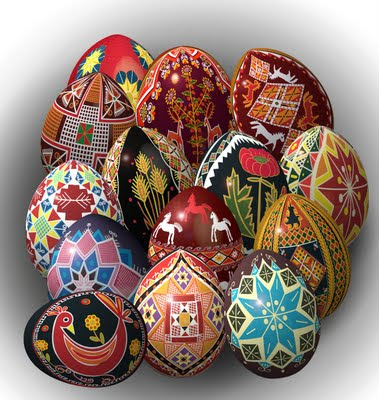
At first, I started out completely in the dark, developing my technique as a went along. I was a shameless cheat, creating symbol sets from GIF and JPEG files of patterns that I had found on the web. Soon, however, I found images of actual pysanky that I admired and tried to imitate. This forced me into learning a variety of new design techniques.
In addition to practicing and learning Adobe Illustrator, I learned more about the symbolism behind authentic pysanka designs.

If anyone has Illustrator and wants to try their hand at creating an egg, I found an excellent tutorial, Create and color an eco easter egg in Adobe Illustrator, that will give you an impressive start.
Thursday, October 8, 2009
Re-discovering Adobe Illustrator
I had worked a little bit with Adobe Illustrator years ago, in another job. Recently, I've had a chance to get into it again as part of the CS4 collection. A couple of things really made it click for me. One was access to the wonderful on-line training at Lynda.com. The other was an interest in the colorful, geometric Ukrainian folk art that one typically sees on Ukrainian Easter eggs (pysanky) and embroidery. The typical venue for embroidery is the rushnyk, which is a kind of ritual towel.
I've found that because I'm building these patterns out of imitation cross-stitches (each is a colored "X"), the overall colors are somewhat pale. This example, for instance, is composed of black, red, green, yellow, violet, blue, and organge. Pretty hard to tell from this distance.

I've had a lot of fun learning to duplicate some of my favorite patterns into Illustrator. After learning to create and transform geometric shapes, I challenged myself to duplicate the actual look of the stitching.
Here is an example of my most elaborate work to date. This is a jpeg of a greatly reduced image. A single pair of the diamond patterns in Illustrator is about 800 points high. Once I create the core of the pattern, I convert it into a "brush" in Illustrator, after which I can apply the brush to any line or arc.
Since these brushes only repeat along on axis, I cannot make decent rectangles. I can, however, make some pretty cool circles.

I've found that because I'm building these patterns out of imitation cross-stitches (each is a colored "X"), the overall colors are somewhat pale. This example, for instance, is composed of black, red, green, yellow, violet, blue, and organge. Pretty hard to tell from this distance.
When I tried to render a complex pattern such as this into Photoshop, I frequently run out of system memory.
Right: a previous attempt at creating pseudo-cross-stitch. 
Wednesday, October 7, 2009
Playing the Race Card(inal)
A couple of days ago, according to the Associated Press, Cardinal Peter Kodwo Appiah Turkson of Ghana said that in light of President Barack Obama's election, there is no reason why the next pope couldn't be black.
Assuming that Cardinal Turkson was speaking of his own chances at becomming pope, my main concern is going to be over the validity of his baptismal certificate.
- Does it have a raised seal?
- Is it signed?
- Does it have any creases?
- What proof will we have that it's an authentic baptismal certificate?
Would any of that even matter? You can go out on the net and download your own template for a baptism certificate.
After all, it's one thing for a black man to be president of the United States. It's another thing altogether to have one as the spiritual leader of the Catholic world. Look what happened when we had a Polish pope.
Wednesday, June 10, 2009
I see brilliant people
Just catching up with old news. In this case, it's a TED presentation, Talks Pattie Maes demos the Sixth Sense, which was posted in March of this year. It's an absolutely brilliant synthesis of technologies: computer, telephone, user interface, etc.
In a nutshell, it's a demonstration of a device that lets individuals pull up and display data on just about anything, from just about anywhere.
Friday, June 5, 2009
Gay rights are apparently not for the faint
An interesting bit of research appeared in the June 3, 2009, ChronicleOnline from Cornell University. It says that there's a correlation between a person's susceptibility to being more easily disgusted and political conservatism.
Assistant professor of psychology at Cornell, David Pizarro, surveyed people with two indexes: the Disgust Sensitivity Scale, and a political ideology scale.
Here are a few cherry-picked highlights from the article:
- Participants who rated higher in disgust sensitivity were more likely to oppose gay marriage and abortion, issues that are related to notions of morality or purity. The researchers also found a weak correlation between disgust sensitivity and support for tax cuts, but no link between disgust sensitivity and the other issues...
- Conservatives have argued that there is inherent wisdom in repugnance; that feeling disgusted about something -- gay sex between consenting adults, for example -- is cause enough to judge it wrong or immoral, even lacking a concrete reason. Liberals tend to disagree, and are more likely to base judgments on whether an action or a thing causes actual harm....
- The research speaks to a need for caution when forming moral judgments, Pizarro added. "Disgust really is about protecting yourself from disease; it didn't really evolve for the purpose of human morality," he said. "It clearly has become central to morality, but because of its origins in contamination and avoidance, we should be wary about its influences."
I'm not sure how to draw my own conclusions. I'm not particularly disturbed by animal blood and guts (human is a very different story), but I am very wary of the gun control agenda. Certain scenes in Brokeback Mountain really give me the willies (no pun intended), but I strongly feel that homosexuals should have equal rights under the law.
Do these contradictions make me a conservative liberal or a liberal conservative?
Subscribe to:
Posts (Atom)