Showing posts with label Rail Trail. Show all posts

Thursday, September 6, 2018

Return of the King

For several decades, the Monarch butterfly (Danaus plexippus) has been steadily declining in number to the point where it was flirting with endangered status.

This year, for the first time in many years, I have been able to catch the monarch in its various guises.  Close to where I work near the riverfront, there was a stand of milkweed growing in front of the Table 9 restaurant.  Until recently, at least, whoever tended the flowers planted there had ignored the patch of milkweeds growing among the planted flowers.

From an ecological standpoint, its amazing what is drawn to the milkweed.  Below, you can see the business end of the caterpillar munching down among what look to be aphids. 


This shot is actually upside-down from the actual orientation.  It just looked too odd when looking at it that way.

In recent weeks, a new generation of monarch eggs had hatched, and I could see about a dozen or so caterpillars munching away.  Suddenly, however, it looked as if someone might have sprayed herbicide on the milkweed plants, because they all withered almost over night.   I feared for the caterpillars.

Fortunately, it looks like the majority have survived.  Most of the chrysalises that I saw were hanging from the concrete window sill in front of Table 9.  Nice, but not a pretty picture.  One caterpillar, however, ventured up into a stand of Chinese silver grass.


I'd actually shot this chrysalis over several days, experimenting with exposures.  The shot above, while looking like a nighttime picture, was taken in morning light.  I used a ring flash and stopped the aperture way down to get this shot.  Unlike the other shots in natural light, this one succeeded admirably in reproducing the stunning golden beads that form a crescent near the top.

I hope I'll be able to catch these pupae as they are close to hatching.   But for now I'll take you back in time to show you the "mother."  I caught this one on the exact same plant that the caterpillar was on in the first picture.  Although I couldn't see the egg, it looks like she's depositing one on the underside of the leaf.


Here's one back from July 31st, sucking on a milkweed flower:


Cheap thrills for nerd boy.

Tuesday, July 17, 2018

What is in a name?

My lunchtime activity consisted of a quick walk down part of the rail trail near my workplace.  I wanted to try out the photostacking portion of my digital camera's Magic Lantern software.
I was using a monopod, but there was no breeze today, so I got a nice sequence of eight shots of a Toadflax (Linaria vulgaris).


The focus stacking worked out pretty well, as you can see in the above composite shot.

This pretty little relative of the snapdragon is an invasive species in North America.  It's quite successful around here, because it thrives in disturbed land.  And West Virginia is a pretty disturbed land.

The flowers are largely closed off by the underlip of the plant, so it takes a strong insect like a determined bee or a bumblebee to pry its way into it.

Because of its widespread range and its long history as an herbal, the Linaria vulgaris has a long list of aliases:

  • brideweed
  • bridewort
  • butter and eggs
  • butter haycocks
  • bread and butter 
  • bunny haycocks (ok, what are haycocks?)
  • bunny mouths 
  • calf's snout 
  • Continental weed
  • dead men's bones 
  • devil's flax 
  • devil's flower 
  • doggies 
  • dragon bushes 
  • eggs and bacon  
  • eggs and butter 
  • false flax 
  • flaxweed 
  • fluellen 
  • gallweed 
  • gallwort
  • impudent lawyer (is that a great name, or what?)
  • Jacob's ladder
  • lion's mouth 
  • monkey flower  
  • North American ramsted
  • rabbit flower 
  • rancid 
  • ransted 
  • snapdragon 
  • wild flax 
  • wild snapdragon 
  • wild tobacco
  • yellow rod
  • yellow toadflax
Haycock, I just learned, is the name of a small conical haystack, usually only three or four feet in diameter and six or so feet high.
Now, don't tell me that you didn't learn something today.

If you want to surf the web some more, by all means check out Haycocks No.09.

Friday, July 13, 2018

Back in Black (and White & Yellow)

It has been years since I've seen a Monarch Butterfly up close.  This long dry spell was broken a couple of days ago, when I snapped this shot in front of Table 9, which is adjacent to the Rail Trail.


Although slightly out-of-focus, this is an interesting shot with a little photobomber bee coming in from the left, and a red milkweed beetle hiding among the flowers on the right.

By some estimates, the population of these butterflies has decreased by 90% in the past couple of decades.  These once-common butterflies became victims to their unusual lifestyle, which involves a yearly migration to overwinter in Florida and Mexico.  Theories for their swift decline include habitat loss due to herbicide use, loss during migration, predators, and parasites.  Maybe it was a perfect storm including all of the above.

This morning, while waiting for my bagel and coffee order at the River Birch Cafe, I stepped outside to revisit the same patch of milkweeds where I had seen the butterfly.   I didn't see any signs of my friend, but I found something just as good:  a sign that the circle of life was still turning.


This is literally the first Monarch Butterfly caterpillar that I've seen in more than a decade!  From the looks of the size of this munchkin, it won't be long before it's ready to metamorphose.

Here's to hoping that they manage to survive the sixth great extinction!

Wednesday, April 25, 2018

Cheap Frills

The bloodroot (Sanguinaria canadensis) is said to be quite variable in flower and leaf.  I shot this one in the Arboretum last Saturday, where it is shown displaying its frill in a threatening manner.


Although this type of behavior is typical of certain animals, it's not at all common in the plant kingdom.


The juice of the bloodroot is red and poisonous, but at least it doesn't spit.  The other plants nearby nonetheless felt threatened.

Tuesday, April 24, 2018

Spring in the Arboretum

Took a stroll down the rail trail to the bottom of the WVU Arboretum last Saturday.  The highly variable weather we've been having has had a strange effect on the wildflowers there.  I went for the Bluebells, but they weren't anything like what they've been in previous years.

Here's a panorama shot, facing up hill.


What was impressive was the volume of plants like Trout Lily and Wakerobin.


I learned something new about the Wakerobin.  There are a couple of closely related species of it.  I've always thought that this is the red trillium or wakerobin (Trillium erectum), but now I've leaned that this might also be a furrowed wakerobin (Trillium sulcatum), which is more southern and also grows in this state (W.Va.). Although quite similar, you can tell them apart by the smell: Trillium erectum smells like rotten meat and Trillium sulcatum smells faintly musty, like fresh fungus. Sorry to say, but I did not think to smell this.

Monday, March 26, 2018

A tale of two shots

I took some time off from work last Thursday and made a brief trip up to Desker's Creek in Preston County.  There was still a good bit of snow on the ground, and I didn't exactly come prepared to do what I did, which was to work my way down into a ravine that held a torrent of icy water.

Not knowing what I'd do next, I fired off a bunch of shots with my camera.  This one has certain aesthetic elements, as I composed it for all of the triangles in the picture:  the fallen tree, the path of the water, the sky, etc.


You can follow certain rules of composition and make the best out of a sow's ear, but this picture is still a sow's ear.  It's too busy.  The snow-covered tree is interesting, but there's just too much going on here.

I mustered the courage to climb up and go back down a little further up stream.  I crawled onto a boulder and took this next shot.


This one doesn't scream "winter" like the other one.  You have to look carefully to notice the snow.  And the composition is pretty straightforward here:  law of thirds, with the top of the falls and the bottom of the falls taking up the middle third.

Still, this picture is way nicer than the previous shot.  It's the one that made it worth falling on my ass for.

Monday, September 25, 2017

Three Eyes (What You Gonna Do Now?)

A lunchtime walk down the rail trail today had me admiring the wildlife on a goldenrod flower.
Meet the Paper Wasp (Polistes):


This shot really shows off the three simple eyes or ocelli that are between the wasp's compound eyes. I read on the old Wikipedia that these ocelli are more strongly expressed in flying insects, especially wasps.

From what I've read, these eyes suck at discerning forms, but they are better than compound eyes at seeing light.  Think of them as little light meters. The jury is still out as to their exact function.

In an exclusive to Blogging the ImaginationTM, here's another shot of our lovely little sister:


The title of this post is a tip o' the hat to The Lovin' Spoonful song Four Eyes.

Monday, May 15, 2017

Ferny

Another Sunday afternoon on the rail trail, at my favorite section above Little Falls.  I was on foot once again, being afraid to cause more damage to the bumper of my Mazda CX-5 by wrestling a bike in and out of the back.

I saw a nice stand of ferns, which look somewhat different from the rest of the ferns along the rail trail.  These look more like some form of maidenhair:


I took this shot with the idea that it would make an interesting screen texture.  This is an Enfused shot composed of three bracketed exposures:  1/25, 1/50, and 1/100 sec at f/13,  The Enfusion is similar to an HDR shot, but I think it gives a more faithful mixing of the high and low ends of the exposure spectrum.  Honestly, I find it hard to see a difference between the Enfused and the HDR versions, but I'm discounting the fact that I had done a bit of laborious darkening of some of the foliage in the HDR version.

Here is the Enfused version (left) next to the HDR version (right).  See if you can tell the difference:

Friday, October 10, 2014

Horsetail

Meet the Water Horsetail (Equisetum fluviatile).


This one was growing along side the rail trail near Masontown, WV.

I've been fascinated by these plants because they are considered living fossils, related to plants from the Carboniferous age 300 million years ago.  When I was a kid living in Bath, NY, I discovered a bed of  fossil Calamites in the cliff face of Mossy Bank, where I lived.

Though I've never dabbled with it, the Water Horsetail has a long history as a medicinal herb. Ancient Greeks and Romans used Horsetails to stop bleeding and treat kidney ailments, ulcers, and tuberculosis, and the ancient Chinese use it to treat superficial visual obstructions. 

Friday, September 19, 2014

Silly Goose

These Canadian geese were sitting on a log in the Monongahela river.  I imagine they're on their way south, but I wonder if the silly geese know this river is flowing north.


If they stuck it out, they'd eventually be going down the Mississippi.   Wonder how long *that* would take?

Some Googling tells me that it's 102 miles from Morgantown to Pittsburgh.
It's 981 miles from Pittsburgh to Cairo, Illinois.
From Cairo, it's another 871 miles to the Gulf Intercoastal Waterway -- assuming we're going all the way south.

Total = 1,954 miles.    For everything else, there's MasterCard.

One thing for sure, it has to be a lot shorter as the bird flies!

Wednesday, September 17, 2014

Morning on the Mon

Went to work a little earlier today in the hopes of catching rowers on the river.  No luck; they don't start until next week.   And I'll have to arrive even earlier.

So, here's the scenery without the rowers.


Monday, September 8, 2014

Knock-kneed goats and bow-legged sheep

Meet the White Snakeroot (Ageratina altissima), which is native to eastern North America. Snakeroot contains the toxin tremetol.


According to Wikipedia, when cattle eat the plant "the meat and milk become contaminated with the toxin. When milk or meat containing the toxin is consumed, the poison is passed on to humans. If consumed in large enough quantities, it can cause tremetol poisoning (milk sickness) in humans." During the early 19th century, large numbers of European immigrants were killed by milk sickness.

The plants are also poisonous to horses, goats, and sheep. Signs of poisoning in these animals include depression and lethargy, placement of hind feet close together (horses, goats, cattle) or held far apart (sheep), nasal discharge, excessive salivation, arched body posture, and rapid or difficult breathing.
So, if you're a farmer,watch out for knock-kneed goats and bow-legged sheep.  It could be a sign.

Sunday, August 10, 2014

Silver-bordered fritillary

A silver-bordered fritillary (Boloria selene), I think:


Saturday, August 9, 2014

Superbum

It's pleasing to come across a new wildflower.  Meet the Turk's cap lily (Lilium superbum), found growing beside Decker's Creek near Masontown, WV.   It is native to the eastern and central regions of North America.  


Thursday, July 10, 2014

Lock 'n Dam

Took a walk in the other direction on the Rail Trail at lunch today, toward the Morgantown Lock & Dam.  I wanted to give the HDR Bracketing feature of Magic Lantern a try.  Here's a quick and dirty:


Unlike many of the features in Magic Lantern, HDR Bracketing isn't rocket science.  You can use the basic Canon menu setting for Exposure Compensation/AEB in aperture priority mode, and fire off three shots.  Magic Lantern's HDR Bracketing just presets an exposure bracket and then automatically fires off the three shots for you.

Here's a different group of shots and a different HDR setting:

Wednesday, July 9, 2014

Canas in the Park

At lunch today, I shot this Orange Cana Lily at McQuian park.


I didn't eat it.

Wednesday, April 23, 2014

Beauty and the Beast

Just this morning I was reviewing some of my "second string" shots from my Easter Sunday wildflower walk.  This picture of Spring Beauties (Claytonia caroliniana) caught my notice because the focus was particularly nice.


Then I zoomed in and noticed all of these little photo-bombing ants crawling around many of the blooms.

Monday, April 21, 2014

Easter Flowers on the Rail Trail

I have yet to break out the bicycle this year.  Instead, I took advantage of a nice, seventy degree day to walk the rail trail up from Little Falls.

The right bank of the road going down to Little Falls always has clumps of Bluets (Houstonia caerulea).


This is a good year for them.

Once at the rail trail, I strapped a tripod on my back and grabbed my macro lens and ring flash.

The first flowers that I saw were Spring Beauties (Claytonia virginica), which were everywhere.  Here's an interesting shot of some poking through the leaves.  Unfortunately you can't see their foliage here, but you do get a relatively rare double-bloom.


Near an old coal mine portal, the hillside was full of Dutchman's Breeches (Dicentra cucullaria).


These look like they're being hung out to dry.

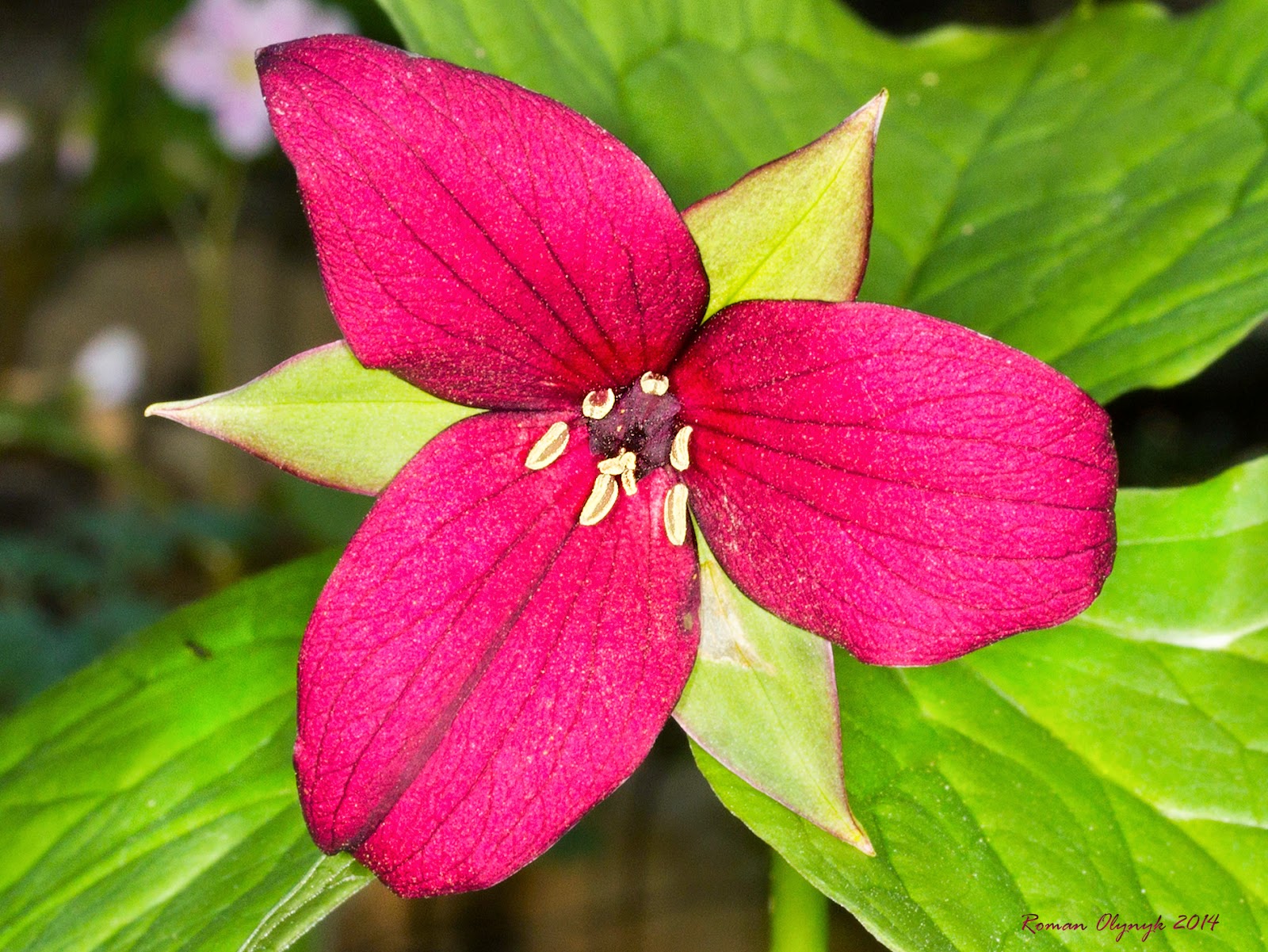
While looking unsuccessfully for Jack-in-the-pulpits, I did find some nice Trilliums.  Here's a close-up of the Red Wake-Robin (Trillium erectum):


There was also a more common White Trillium.  At first, I thought that they may be the white variety of the Trillium erectum, but I read that they are supposed to have dark purple gynoecium. I guess that makes this one a Great White (Trillium grandiflorum):


Monday, April 14, 2014

Oh, Ruby (Don't take your love to town)

Today's weather is cloudy with a chance of evening thundershowers.  This is also the time of year when the tree blossoms are peaking down along the waterfront at Hazel Ruby McQuain Park.  I stopped off on my way to work this morning and took a few shots with the Lensbaby Composer.  Despite it being a "golden hour," the colors were pretty muted.


Not leaving well enough along, I took the picture home, where I could post-process with Nik's Color Efex Pro, making it a little warmer.  Since I could add a little blue to the pasty sky, I recropped and provided more of the original image.  


Link to today's eponymous title.

Monday, December 2, 2013

Lensbaby Part 2

Took my lunchtime walk along the rail trail with Lensbaby in hand.  It isn't the nicest of days for outdoor photography, and I don't have anything notable to show for the effort.  So with that caveat, here's my nicest shot.


This is looking up Decker's Creek under the bridge on University Avenue, near the Waterfront Park.  I took it from the railroad bridge of the rail trail.